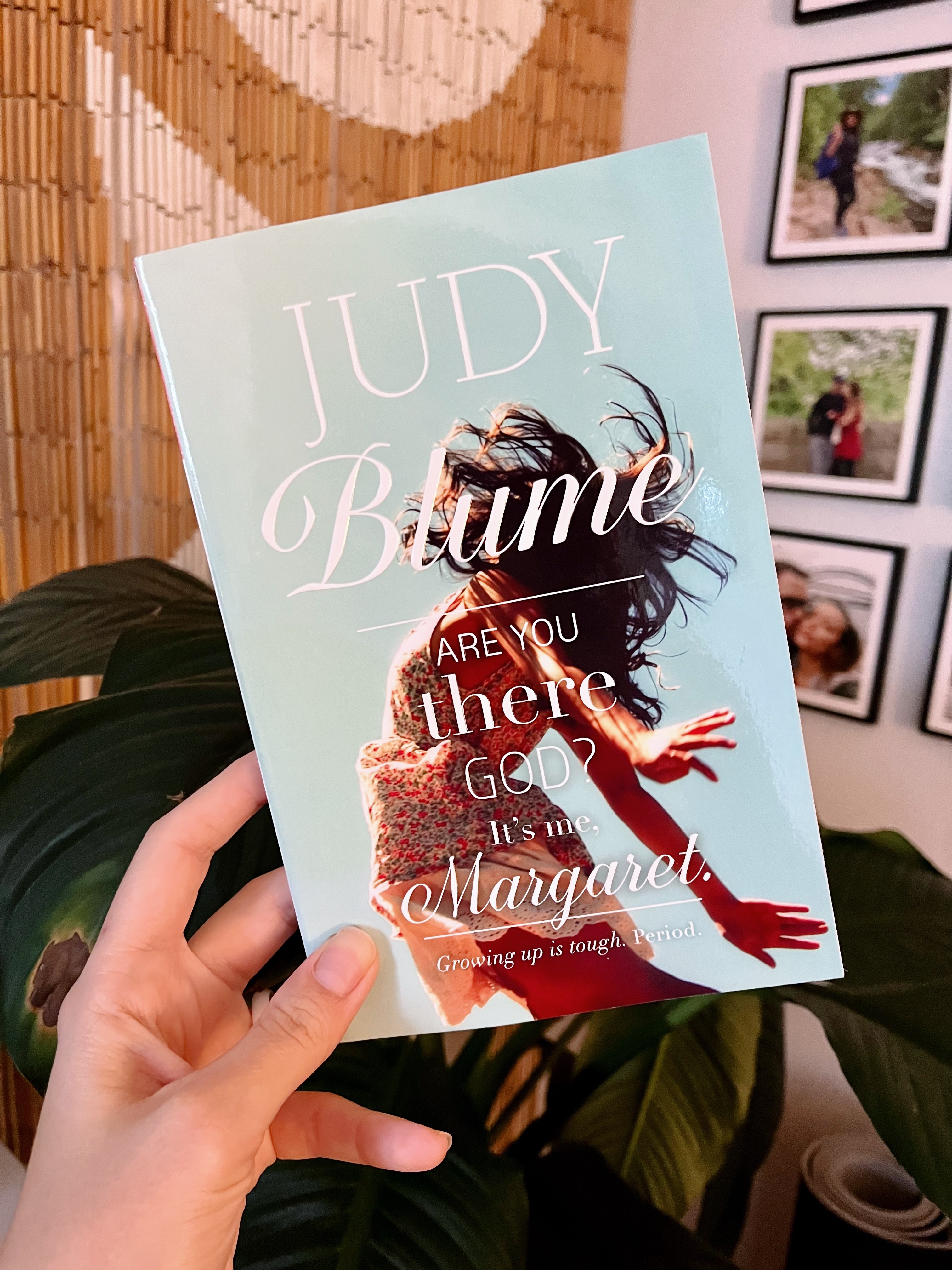
I don’t remember reading Judy Blume’s classic novel, Are You There God? It’s Me, Margaret. When I was a child. However, I very well may have because I remember the book cover on my shelf. I loved her other books, Double Fudge and Freckle Juice, if only for their titles.
Despite not remembering, some parts triggered an emotional recall towards the novel’s end, as if I’d read it before. It felt nostalgic, like I was suddenly transported to my second-grade library during book fair, how I’d touch all the books and wish they were mine, or in my childhood bedroom, the one with a pogo stick leaning against the wall and Polly Pockets rubber clothes scattered around. In the same bedroom, my Grandma Barbie showed me how to line books on the shelf, going from tallest to smallest.
Yes, some part of me felt like I’d been here before. But perhaps that’s the magic of Judy Blume. The spark of Margaret. She is all of us in some way. A reminder of how adolescence felt, the forgotten trinkets and challenges of twelve or eleven or eight years old.
As an adult reader, I cherish that nostalgia, and the film felt just the same. The character dynamics from Margaret to Barbara to Silvia felt fleshed out, just like Margaret in the book. We relate to them; we watch and say – that’s my grandma or aunt or father or mother; I did that; I remember that; Oh, yes, I felt that way; I feel like that now!
We read, and we watch, and we analyze as adults from a different lens. We realize that human interactions are the biggest conflict, and maybe we knew it then, too. But we didn’t have so many words to describe our feelings. The world of religion and biases and hate didn’t feel as big. Perhaps we read back then and related to the troubles of getting our first bra or fitting in at school. Now, we may analyze things deeper, think about how religion causes our divide because we use it to mistreat others, and that’s not a concept avoided in this book.
Margaret talked to god before she had a religion. It wasn’t until the adults fought over which religion was right or wrong did she have conflict. Margaret felt god most when she was alone.
“I’ve been looking for you God. I looked in temple. I looked in church. And today, I looked for you when I wanted to confess. But you weren’t there. I didn’t feel you at all. Not the way I do when I talked to you at night. Why God? Why do I only feel you when I’m alone?”
– Margaret (Are you there God? It’s me, Margaret by Judy Bloom)
But it’s not an invisible spirit you speak to that causes harm, but how that invisibility is used for human selfishness, judgment, and suppression.
“What I learned about religion is it makes people fight . . . maybe the truth is no one is out there.”
– Margaret (Are you there God? It’s me, Margaret, film adaptation )
Whether you’re part of an organized religion or not, Margaret’s family experiences teach us a few things about spirituality. Religion can connect or divide us, making the world feel expansive or penny-sized. For Margaret, she wasn’t alone when speaking to god – it was therapeutic for her to share the things going on in her life.
I think most of us are searching for a way to connect. Searching for our tribe – people, religion, friendships, family. Whatever you want to call it. It’s beautiful to see the way these connections transcend throughout this novel and film. The grandmother, Sylvia, struggles with loneliness when her family moves to Brooklyn and seems to find a partner in Morris Binamin. Barbara is exploring new roles as a wife and mother in the suburbs, learning to set boundaries and follow her passion.
And, of course, Margaret, over the course of a year, is faced with decisions – who she wants to spend her time with, what type of friend she wants to be, how to be close to god, right versus wrong, and the beginning of womanhood. It’s all the ways we grow through experience – trial and error and learning from others. The more I explore, the more I find. Isn’t that what this book… and life, is all about?
Are You There God? It’s Me, Margaret. Discussion Questions
Topic of Discussion: Children as Narrators
- Does Margaret feel like a reliable narrator?
- Does knowing her age affect the way you read the novel (her perspectives)? Can you see the world through that of a twelve-year-old girl?
- Were there moments when Margaret’s detailing felt false?
- Can you think of other novels told in the voice of a child? How do those compare to Margaret?
“Moments in which adolescent storytelling shines.”
I wrote that exact excerpt in my notebook, as a way to track my pink color tabs in the novel. These were moments when I felt like a kid again.
- What moments from the novel, whether it be through voice/detail/description/emotion, brought you back to childhood?
- How might an adult read this novel compared to a child?
- Did you read Are You There God? It’s Me, Margaret, when you were a kid? How do you remember the story, as compared to how you perceive it now?
- What lessons can Margaret teach us, no matter our age?
Are You There God? It’s Me, Margaret. Film Questions
- In the novel, Margaret explains to us (the reader) her mother’s relationship with her parents. In the film adaptation, we see Barbara sharing the painful history with Margaret. How does the delivery of information affect our experience of this conflict?
- How do pivotal moments of adolescence mirror themselves to your own experiences? (wearing a bra, first period, childhood crush, religion, family dynamics).
- Aside from general entertainment, why do you believe it was important for the dinner scene to occur the way it did? (grandparents all together, fighting between family members about religion in front of Margaret)
Topic of Discussion: Supporting Characters
I adore Rachel McAdams and Kathy Bates. Both brought life to the original backdrop characters of the novel. With the film adding additional conflicts, such as Barbara’s battle with the PTA, balancing a new life, growing child, and her own relationship with her parents, we see the dynamics shift from adolescence to adulthood.
- How does the film carry readers from childhood into adulthood? Do you find the grandmother, mother, and father roles relatable?
- How does the casting of Rachel McAdams affect the way you view the film/mother character (if at all)?
- If the film was adapted when the book was released (1970) do you think the film adaptation would’ve included some of the key aspects of adult perspectives as it did?
If you enjoyed this post and want to see more from A Movie Lover’s Book Club, check out our February book pick or the bookish archive.

Leave a Reply