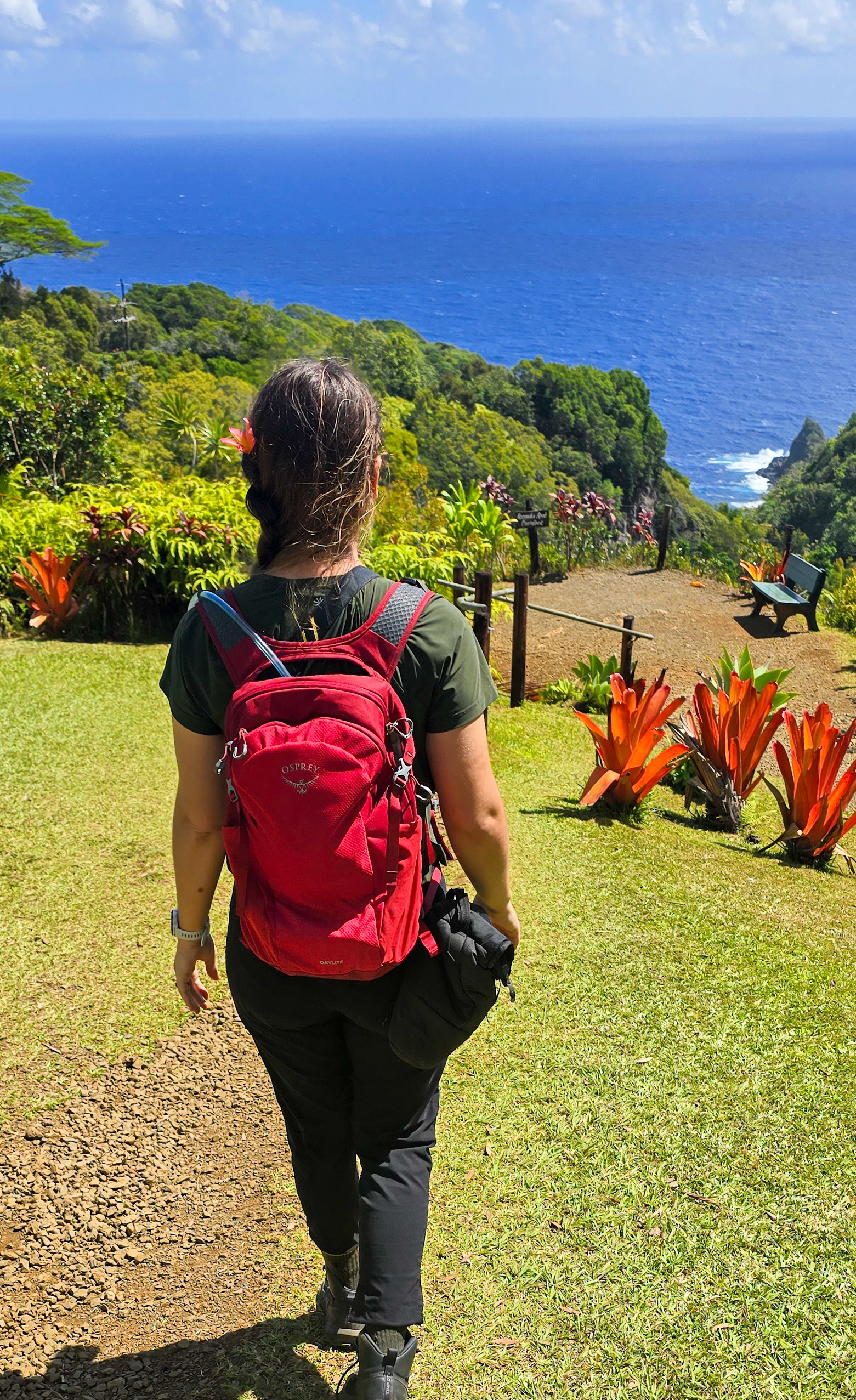
The sky in Hawai’i is almost always visually the same, which would be boring if not for how beautiful its routine. There are, of course, exceptions — the gray days when the sun is hidden behind overcast, or when it storms. Mostly, though, the sky is baby-blue marble, the large white bubble-plumes of clouds its textured complexion, angelic like Constable’s paintings.
This routine, clear and beautiful sky, was a treat for our second day on Maui. On this day, we ventured along the famous Road to Hāna (Hāna Highway). We combined guidance from the Shaka app with a few of our own “must-stops.” The Garden of Eden Arboretum, which the app recommended skipping due to time constraints, was one of those musts for me. Because we knew the garden would add time to our day, we planned accordingly, bypassing some of the app’s suggested stops—no worries about time here.
Quick note: I will share more details in my upcoming Road to Hāna Guide, coming soon.
Why Visit
A lesson I learned early on, when first bitten, as they say, by the travel bug during our trip to Sydney, Australia, is that botanical gardens, no matter where they are or how many of the same species they share, are always worth my time. Each garden has its own unique touch. The Washington, D.C. Botanic Garden, for example, features a “Season’s Greetings” display during the holidays. This display showcases models of D.C.’s iconic landmarks, curated and carved from various natural materials, including gourds, willow sticks, sycamore leaves, cinnamon, pine cones, and that’s just to name a few. Vibrant red poinsettias, the traditional winter holiday plant, surround the displays, adding to the holiday charm. It’s gorgeous, and if you find yourself in the D.C. area during the holidays, be sure to check it out. I wrote a 3-Day Travel Guide for Washington, D.C., which includes photos of the display, you can find that — here.
I’ll sum up my point and save you the highlights from each garden, simply saying that botanical gardens are consistently rewarding experiences, and, of course, The Garden of Eden was no exception in this regard.
Now, I recognize not everyone shares my particular brand of plant passion. If this is the case for you, I understand skipping the gardens. My counterargument, however, is that if you’re a first-time visitor to Hawai’i (whether plants are your thing or not), Maui’s Garden of Eden is a wonderful opportunity to get an up-close look at one aspect that makes Hawai’i so special: its unique plant life. Additionally, as a bonus, the ocean views along the garden paths are unbeatable, and the fresh air is simply good for your spirit.
General Information
The Garden of Eden Arboretum, also known as Maui’s Garden of Eden, is a 26-acre botanical garden featuring trails and overlooks that offer stunning views of the Pacific Ocean and the Puohokamoa Falls.
The property’s owner, Alan Bradbury, purchased the 26 acres in 1991 with the vision of restoring and preserving Hawai’i’s native plant species. According to their website, the gardens are also home to a diverse array of tropical flora from the South Pacific and various rainforests around the world.
The garden is one of many stops along Hāna Highway, located at mile marker 10.5. GPS will take you to the gardens, but keep in mind that service on the highway is spotty.
Open daily from 8:00 AM to 4:00 PM, you do not need a reservation to enter, but fees apply (there is a military discount). Check out their website for more details.

When you enter the gates to the Garden of Eden, you’ll quickly come upon a cafe to your left. Stop in for a veggie sandwich with pineapple slaw (delicious) and a drink that is both refreshing to the taste buds and aesthetically pleasing.


If you’re not a fan of peacocks, you might not be a fan of this place, and I might not be a fan of you because, I mean, look at these elegant perfections.


Peacocks in Hawai’i
Peacocks and Peahens (female peacocks), specifically Indian Peafowl (as pictured above), are theorized to have been introduced around 1860; however, their exact introduction date is unknown. Peafowl, unlike other species of game birds brought for hunting, were introduced to the islands because they were, well, pretty to look at.
These beauties are native to India, Nepal, Pakistan, and Sri Lanka, but have an interesting connection to Hawaiian royalty. As the story goes, Princess Kaʻiulani, the last heir to the Hawaiian throne, developed a fondness for peacocks. She homed dozens on her ʻĀinahau estate, a part of the ahupuaʻa (land division) of Waikiki. Locals reported witnessing her hand-feeding the large birds. It is said that when Princess Kaʻiulani passed away, her peacocks could be heard screaming, crying out in sorrow.

.jpg)
Her estate was demolished in 1925, and after decades of transition, it is currently the site of the Sheraton Princess Kaiulani Hotel. It is also believed that the peacocks found at the Honolulu Zoo, located in Waikiki, are direct descendants of Princess Kaʻiulani’s flock.
During my summer working at the Honolulu Zoo, I heard a rumor suggesting that Princess Kaʻiulani’s affection for birds led to Hawai’i making it illegal to kill one. Unfortunately, this rumor is just that, and as of 2025, while it’s highly frowned upon to harm peacocks in any way, it’s not illegal.
Pīkake: The Hawaiian word for peacock is pīkake, and if you are familiar with Hawaiian botanicals, you might recognize the pīkake flower (Jasminum sambac). Princess Kaʻiulani named the flower as it was her favorite. The Princess was known to have worn the flower often, and her fragrance is remembered synonymously with the sweet jasmine buds.

Ti leaf
Two unique components of The Garden of Eden Maui come together spectacularly for my two leading personalities: the cinephile and the naturalist.
First, we have Ti leaf. According to various online resources, including The Maui Ocean Center, the Garden of Eden Arboretum has the most extensive variety of kī (ti) plants in Hawaiʻi. If you know nothing about the plant, you’re probably thinking, ‘ Who gives a shit? ‘ But, Ti leaf, while native to Polynesia, holds sacred and spiritual significance in Hawai’i (there’s a little reason to give a shit).
Ti leaves (Cordyline fruticosa) as described by Kapiʻolani Community College:
“Polynesians brought Ti leaves as a source of food, although tī developed greater cultural significance through its growth within the islands. Known as “Ki,” the Hawaiians believed the plant was sacred to the Hawaiian God Lono and Goddess Laka of hula, conveying itself as a common symbol of high rank and power. In addition, it was thought that Ti had the ability to ward off evil spirits and was often placed bordering farmlands and houses to protect the enclosed areas.”
“There is a legend that states that if there is a suspicion of a shark or supernatural creature in the water, you can place a Ti leaf in it to determine if it is safe. If the Ti leaf sinks, it is dangerous and if it floats, it is safe to enter.”
— Kapiʻolani Community College, on Cordyline Fruticosa
When you consider this information, kī (ti), plants are pretty cool, and the opportunity to see a large variety is precisely what this plant nerd, and possibly you too, classify as a good time.

Keōpuka Rock
Next, for my fellow cinephiles, we have Keōpuka Rock, also sometimes referred to as Jurassic Rock, for its famous feature in the opening scene of the 1993 film Jurassic Park. Just behind a helicopter tour of the valley, the Garden of Eden is the next best way to view Keōpuka Rock. Otherwise, you can see the natural landmarks from a significant distance at viewpoint stops, located farther along the Hāna Highway past the gardens.
As you can see, I failed to capture a photo of Keōpuka Rock alone, but my husband snagged a photo of me with the rock in the background. I guess you’ll have to visit to see it for youself.

Final Thoughts
Wandering the lush grounds of the arboretum is the perfect chance to stretch your legs, especially if you intend on going the distance *insert Hercules vocal track here.
Reminder: The Garden of Eden is located at mile marker 10.5, and we are heading to mile marker 43, the Pipiwai Trail, in Haleakalā National Park, which is approximately 1.5 hours away, assuming no stops and no traffic. However, the name of the game when venturing the Hāna Highway is to enjoy the ride, take your time, and make stops along the way. So, we expect a 2-3 hour drive still to go.

We thoroughly enjoyed our walk through the gardens. There was enough property and paths; I didn’t feel crowded with people. It was easy to let the mind go and focus on the present instead of the journey ahead. This says a lot, especially when on vacation, where it’s sometimes easy to get wrapped up in the excitement and the ‘what comes next‘ mentality—just another reason why I enjoy botanical gardens. The outdoors, gardens, they call to our focus. It’s not new news that science supports the fact that our brains love and benefit from exposure to plants. A portion of these benefits include: reduced stress and anxiety, promoting relaxation, and improvements in memory and general mood. That’s a whole lot of reasons to get outside.
If you’re interested in learning more about the psychological effects of nature on your brain, here is a great article by the American Psychological Association, Nurtured by Nature.


There are many treasures to marvel here — statues of goddesses and mythical creatures, vibrant flourishing blooms, and resting buds. The air is a dazzling blend of rainforest: fallen leaves of rainbow eucalyptus, night rains caught on banana leaves, plumeria flowers the color of sunset, and the ocean brine carried along breezes, crashing waves, and smooth waters — all of it culminates into the simplest of terms, bliss. I felt it, and perhaps, as the name would suggest, while you walk the paths of this nurtured garden, you too will find yourself in your very own version of Eden.

A Note: This post was 100% human-made. At no time did I use A.I to write this article. Images you see on this post were captured by me (or my partner) unless otherwise stated (credited/linked). Thank you for reading! 🙂
Resources I used to create this post:
- About kī (ti) plants
- Ahupua’a Definition
- American Phsycological Association, Nurtured by Nature
- Bishop Museum – Indian Peafowl
- Favorites of the Royal Princess Ka’iulani by: Kamaka Pili
- Kapiʻolani Community College, Cordyline fruticosa
- Maui’s Garden of Eden
- Pīkake Definition
- Photo of Princess Kaʻiulani’s residence at ʻĀinahau
- Plant Based D.C. Land Marks – Botanic Garden
- The Maui Ocean Center
- The Royal Pīkake Flower
Leave a Reply