My Amazon travel journals, like my Pacific Crest Trail journals, combine excerpts from my journal, which capture the events as they took place, with my ” in-retrospect” reflections or thoughts as they came to me while I wrote this. If you haven’t already, check out Amazon Travel Journals: Day One Headed to the MLC

Thursday, March 28, 2024
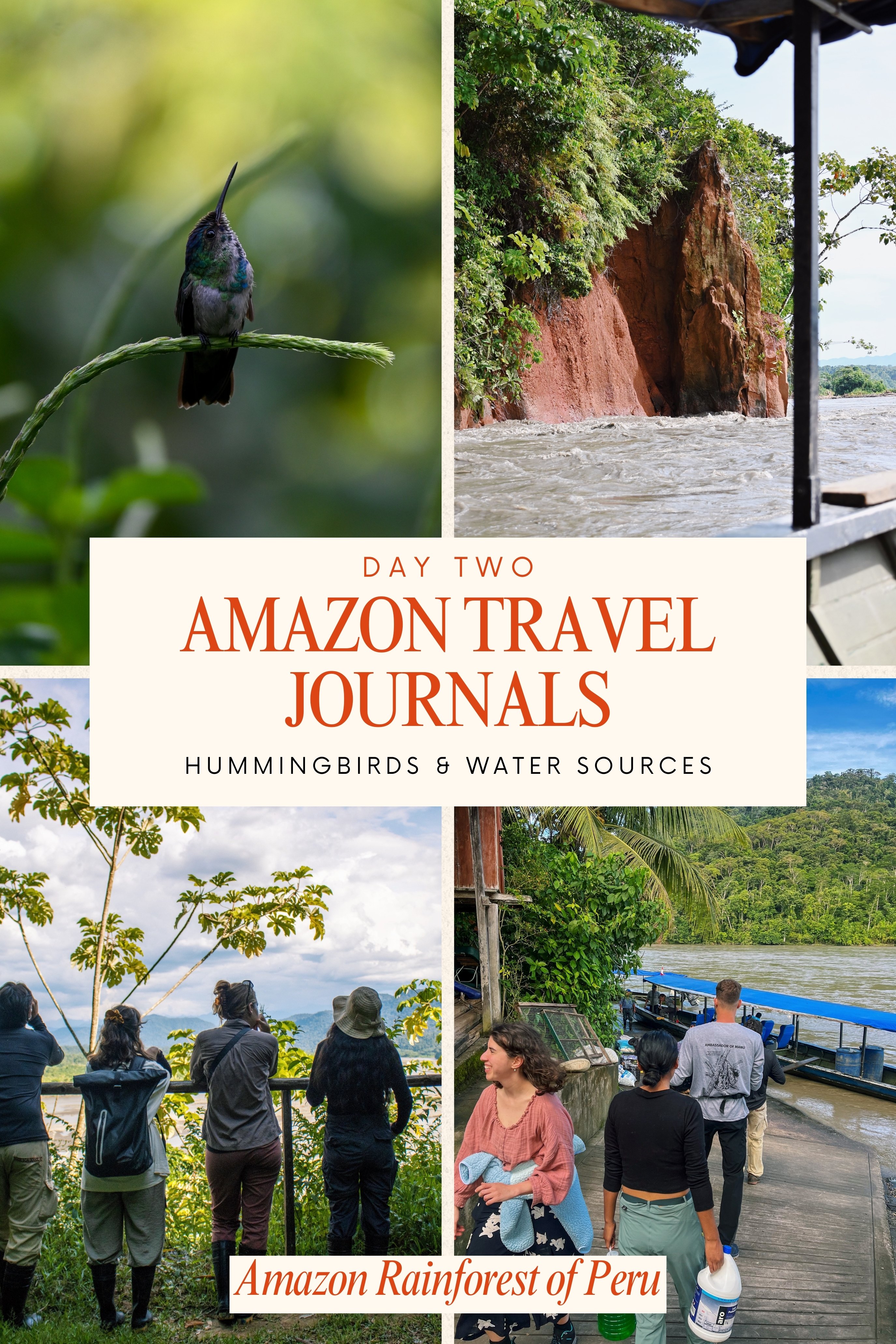
We arrived by boat at Crees, Manu, the MLC (Manu Learning Center). Like many parts of the Amazon, the MLC is reachable only by boat.


We helped unload the food and equipment, which consisted of numerous crates of glass-bottled sodas, fruits, vegetables, meat, soy meat, rice, sugar, cleaning products, and plenty of other things I’m not remembering.
Some items were for our three-meal-a-day serving, and some items were to stock the mini store for visitors and volunteers—this was where I’d buy a glass bottle of Coke and a Snickers bar every day like it was my religion.
Pepe and Emma gave us a tour of our rooms and the grounds. This included a short walk in the Rainforest to a point that overlooked the river.

Day two was for settling in. I share a room with Lou. Adam and Daan share a room. Staff members have their own accommodations separate from volunteers. The MLC is also a sustainable lodge. Travelers can book at various times of the year. So, similar to staff, volunteers and guests all have their own accommodation set-up.

Only two visitors passed through during my time at the MLC: a man and a woman who traveled to more remote parts of the Amazon to talk to local tribes, specifically in the interest of clean water. Their organization – Rainforest Flow
We were just a blip on their travels, but we shared a wonderful conversation over breakfast before they left. The man, I don’t recall his name, wanted our opinion on ways to market awareness for sustainable water in remote areas of the Rainforest, where people don’t have access to safe, drinkable water.
What do I mean by “market awareness”? Well, how often have you watched a commercial on television or scrolled past campaigns on social media featuring suffering children, ones going without water?
When you see these campaigns, do you feel something: an urge to donate, learn more? Do you immediately think about the parallels of your own country? The starving, thirsty people in your community. Do you dismiss others in these “far-off regions of the world” because of it?
These are not questions loaded for judgment. These were questions we asked each other while sitting around the table. Lou is from London, Adam is from a small town in Scotland, and Daan is from the Netherlands, a region he swore we’d never heard of (he was right, but I’d love to visit one day). The other two visitors (the ones encouraging the conversation) are from the United States. This discussion with people from different backgrounds and regions of the world brought varying perspectives to the table.
We agreed to being relatively naive about the situation in the Amazon. Yes, of course, we’ve seen these campaigns, and we know people are suffering, but how that suffering is presented to us has always been in a way where we care and dismiss—care and dismiss.
That’s the truth, isn’t it? Many of us, not all, care but dismiss because what can we do? If we were to help anyone, shouldn’t it be the neighbor nearest going without?
What if you understood things differently? The point of the conversation was why everyone worldwide should care about safe water in the Amazon Rainforests. So, why should we care?
Perhaps you saw the recent viral video of the usually unseen tribe defending land in the Amazon. If you haven’t, you can watch it here.
The video represents one of the most crucial fights for our planet.
The tribes of the Amazon Rainforest are the first line of defense in protecting the Rainforest; however, worldwide decisions affect their ability to survive, their home, and the home of the most diverse ecosystem in the world.
Health for the Amazon ecosystem and its people means health for the planet.
The conversation with the people from Rainforest Flow didn’t occur on my second day; it was more like my third or fourth. I included it because it fits well and because my goal for each entry is to include a conversation piece, important topic, or reflection, and my journal was relatively dry from this day.
Now, back to day two, where we’ve just settled into our rooms; if you’re me, that means you’ve dumbed your bag in the corner (zipped, always zipped to avoid unwanted guests in your bag, and I don’t mean people, more like snakes, bugs, or rats) only truly unpacking toiletries for the bathroom. Also, random essential items for your bedside table including books, notebook, camera, headlamp, etc.
If you’re Lou, unpacking means neatly organizing everything in your linen closet. I just adore her, honestly.
She makes everything special and most things funny. Her personality reflects her heart; it’s open and honest; the more time I spent with her, the more this is apparent.
After unpacking, I opted for a shower in the communal bathrooms. Our room includes a bathroom with a shower, but I was interested in the hot water situation in the communal option.
It was still daylight, so I didn’t need a headlamp. Like the Cloud Forest Lodge, the lights at the MLC run on a solar-powered generator. They run the generator for about three hours a few days a week, which gives us time to charge our phones, cameras, and other devices.
The bathroom has an open floor plan. You walk up a few steps, and if you go straight, you’ll find an outdoor space where we do our laundry (wash by hand and line dry). You can also access the laundry area from pathways along the side of the building. To the left are the men’s bathrooms, and to the right are the women’s. Each has a walkway with open windows, but there are stalls housing a private toilet, sink, and shower. It’s a really nice set-up. As you can imagine, the property is a diverse landscape of greenery.
I mean, it’s the Amazon Rainforest. Naturally, you want as much exposure to the outermost beauty as possible.
The showers is where I saw a turnip-tail gecko—one of the largest geckos I’ve ever seen. It was high above in the rafters. Certainly, enjoying the moisture from the steam of my shower.
Instantly, I felt joyful at the surrealism of it all, similar to the moment the night before, when I took a breath and realized where I was.
After my shower and a fresh set of clothes, I walked around the property, photographing all the hummingbirds. I’ve never seen so many in one place.

This image is part of The Wildlife Photography Project | Learn More
Daan, Lou, and I sat around playing cards. Eventually, Adam joined in, too. We ate dinner together, and afterward, Pepe reviewed our schedule for the next day.
I want to tell you more about the MLC, their work, and how we, as volunteers, were involved. But that’s the perfect topic for “Journal Entry, Day Three,” where we have our first surveying and field experience, which will be published next week.

Photo Wall


Leave a Reply